
For decades, we’ve treated energy production and agriculture as a zero-sum game. Every acre covered in the steel and glass of solar panels was an acre permanently lost for the plow or cow.
Given that food insecurity is already high, even in the United States (where hunger affects one in seven people), and that global food production will need to scale 70% by 2050 to meet a growing population, it’s a reasonable worry to have.
At least, on paper.
The reality is that food and energy don’t have to be at odds with each other. They can, in the case of agrivoltaics with high-clearance solar, be two sides of the same (very profitable) coin.
If we want to secure our food supply and provide a viable path forward for American farmers, it’s time to stop leaving that money on the table. It’s time to start investing in systems that invest in both a healthy food system and clean power.
What is Agrivoltaics?
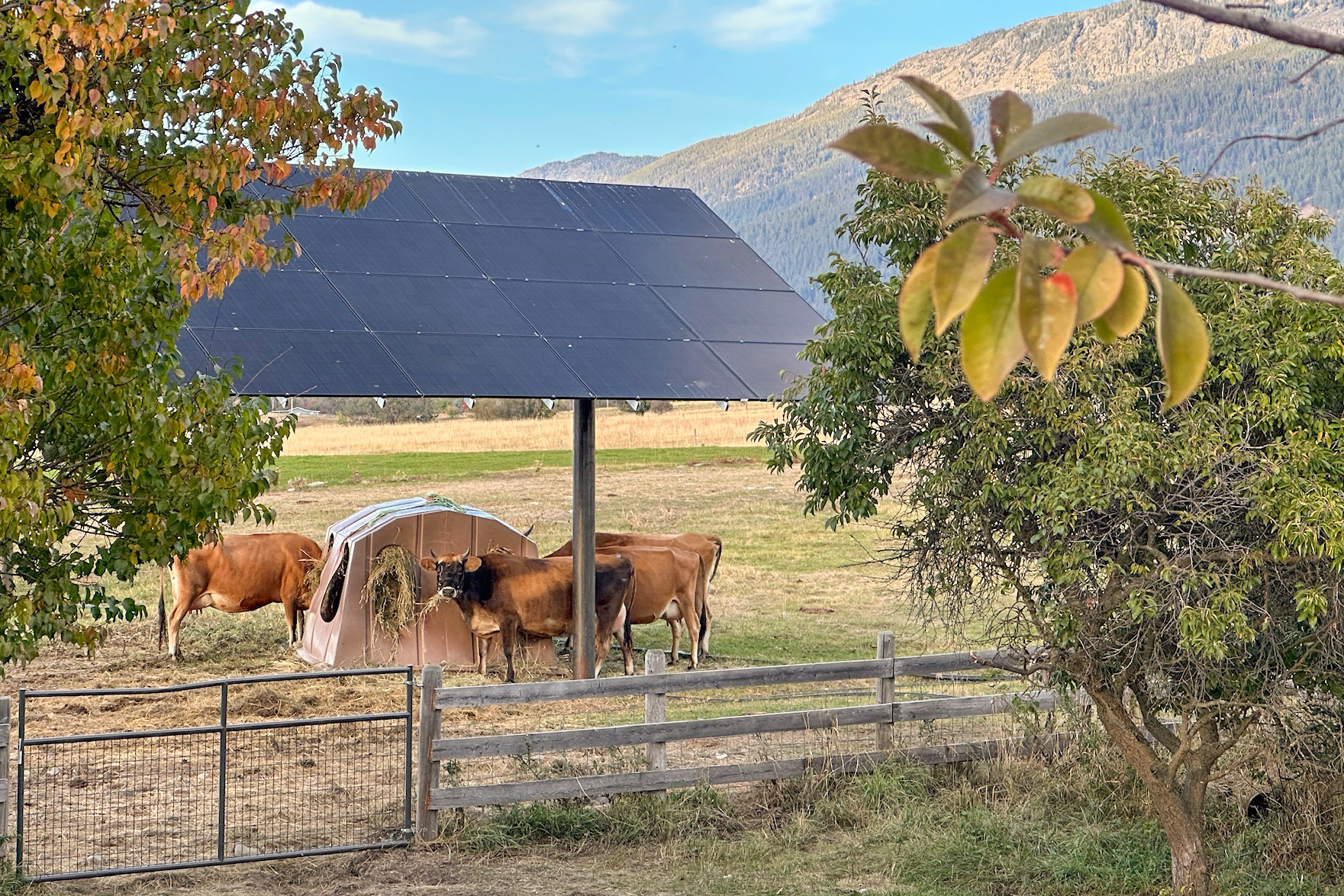
Sometimes seen as a mere buzzword in the clean energy industry, agrivoltaics offers real, lasting benefits for preserving farmland and protecting food security.
It is a system that combines agricultural cultural production with renewable energy generation, all on the exact same plot of land.
In a dual-use system, solar panels provide shade for animals or plants, reduce water evaporation and erosion, and protect crops from extreme weather. In 2026, farmers all over the country are successfully raising sheep, cattle, poultry, pigs, bees, vegetables, fruits, and even row crops like corn under and around these arrays.
The Role of High-Clearance Solar
It’s important to note that not all solar is equally suited to agrivoltaics, nor are all types of farming suited to “traditional solar.”
Standard ground-mounted solar is generally installed with just 18 to 36 inches of space between the ground and the leading edge of the panel. This layout is designed to optimize energy production while minimizing material costs. However, it poses a major barrier to agrivoltaics.
For a while, these problems have been easily mitigated by judicious selection of agricultural activities: sheep, typically seen as the “plug and play” on solar sites, don’t need much space to wiggle under the panels and graze on the forage beneath them. Three feet or less suits them just fine.
The same cannot always be said of larger species of livestock (like cattle) or when dealing with large, mechanized equipment (such as what would be used for hay production).
We’ve sidestepped these issues for the last decade, plugging in sheep on sites instead, but the reality is that a healthy agricultural economy demands diversity. Sheep are wonderful, but we need to consider solutions that work well for a range of crops and livestock species.
High-clearance solar, installed at six to twelve feet or higher, is specifically designed to fill that niche. Cattle can graze safely beneath solar installations without a rancher having to worry about them brushing against the panels, and there’s more space beneath and around them for the cultivation or harvest of other crops, too.
The argument against “raising the arrays” has always been one of cost and stability. Traditional high-clearance solar requires higher upfront costs, longer installation times, and more complex engineering (due to factors such as increased wind loading).
MT Solar, however, is challenging the status quo with its solar racking systems like AgriBeam, which offer a more efficient assembly with 95% of construction completed at ground level and a patented hoisting system.
How Does Agrivoltaics Increase Yields?
Critics like to claim that livestock suffer under the panels, assuming the animals face excessive heat and poor nutrition, and argue that will result in reduced yields for farmers.
The reality is the exact opposite; solar panels create a shaded microclimate that protects livestock from intense sun. Sheep grazing under the panels experience far less heat stress, consume much less water, and reach heavier weaning weights than animals kept in open, unshaded pastures.
The benefits extend far beyond animal welfare. Agrivoltaics provides measurable advantages across the board:
- Increased yields: Crops grown under panels benefit from weather protection. For example, studies show strawberry yields increase by 18% under solar arrays. While there’s often criticism about yield reductions due to the mere presence of solar panels, which admittedly need to be farmed around, farmers can now produce two crops on the same acreage (one being sunlight, and, say, sheep, or broccoli, beef, etc – whatever the commodity of choice might be).
- Financial stability: Solar leases provide farmers with consistent, reliable income, averaging $300 to $1,000 or more per acre annually. These contracts typically last 20 to 30 years, offering exceptional financial stability regardless of volatile commodity markets.
- Environmental benefits: Intensive rotational solar grazing actively rebuilds topsoil (more on this below), reverses erosion, increases biodiversity, and significantly boosts soil carbon sequestration.
All of these benefits make it far easier for farmers to produce high yields securely without worrying about rising input costs, soil erosion, or a fluctuating commodity market. And when farmers are secure, the food system is secure.
Options to Reduce Topsoil Loss
Beyond increasing yields, agrivoltaics also offers innovative solutions to one of farming’s biggest challenges: topsoil loss.
We lose roughly a pound of topsoil for every bushel of corn that’s produced, and estimates show that more than a third of farmland in the US Corn Belt has lost its carbon-rich topsoil. That’s bad news for farmers, who have to apply increasing quantities of synthetic fertilizers just to produce the same overall yields.
Solar has often been seen as a villain when it comes to topsoil, with early projects sometimes failing to prioritize stormwater management and erosion control. Fortunately, this issue was addressed shortly after, with most states now requiring stormwater management plans for solar development. Developers rely on solutions such as cover crops, which protect the soil, or alternative cover to reduce the impact of driving rain on erosion rates.
How High-Clearance Solar Protects Topsoil
High-clearance solar provides a benefit here. Elevated panels serve as a protective canopy, reducing the direct impact of heavy rainfall and preventing topsoil displacement. Shade from solar panels protects plants from extreme heat and reduces water evaporation, quadrupling the water efficiency of pasture grass. During severe droughts, vegetation beneath solar arrays remains green and lush, providing high-quality forage for animals, while surrounding fields turn brown.
Add in agrivoltaics, and you’ve got a real one-two punch. High-clearance makes rotational grazing more accessible. Livestock grazing under solar panels not only preserves but also actively rebuilds topsoil by incorporating organic matter (manure) into the soil, improving soil health and carbon sequestration while reducing topsoil loss.
Over time, this equates to higher, more sustainable yields. The alternative to rebuilding soil would be for a farmer to spend heavily on inputs or on cover crop seeding, which is often an impractical financial measure.
There are economic benefits woven into this rotational grazing model, too; modeling shows that for a farm spending $210 daily on hay, switching to rotational grazing can save around $8,000 over 120 days. Meat production per acre has also been shown to increase with this model.
Translation: fewer input costs for more production on the same ground (not to mention the additional revenue from leasing the land or managing vegetation).
Food Security and Sustainability
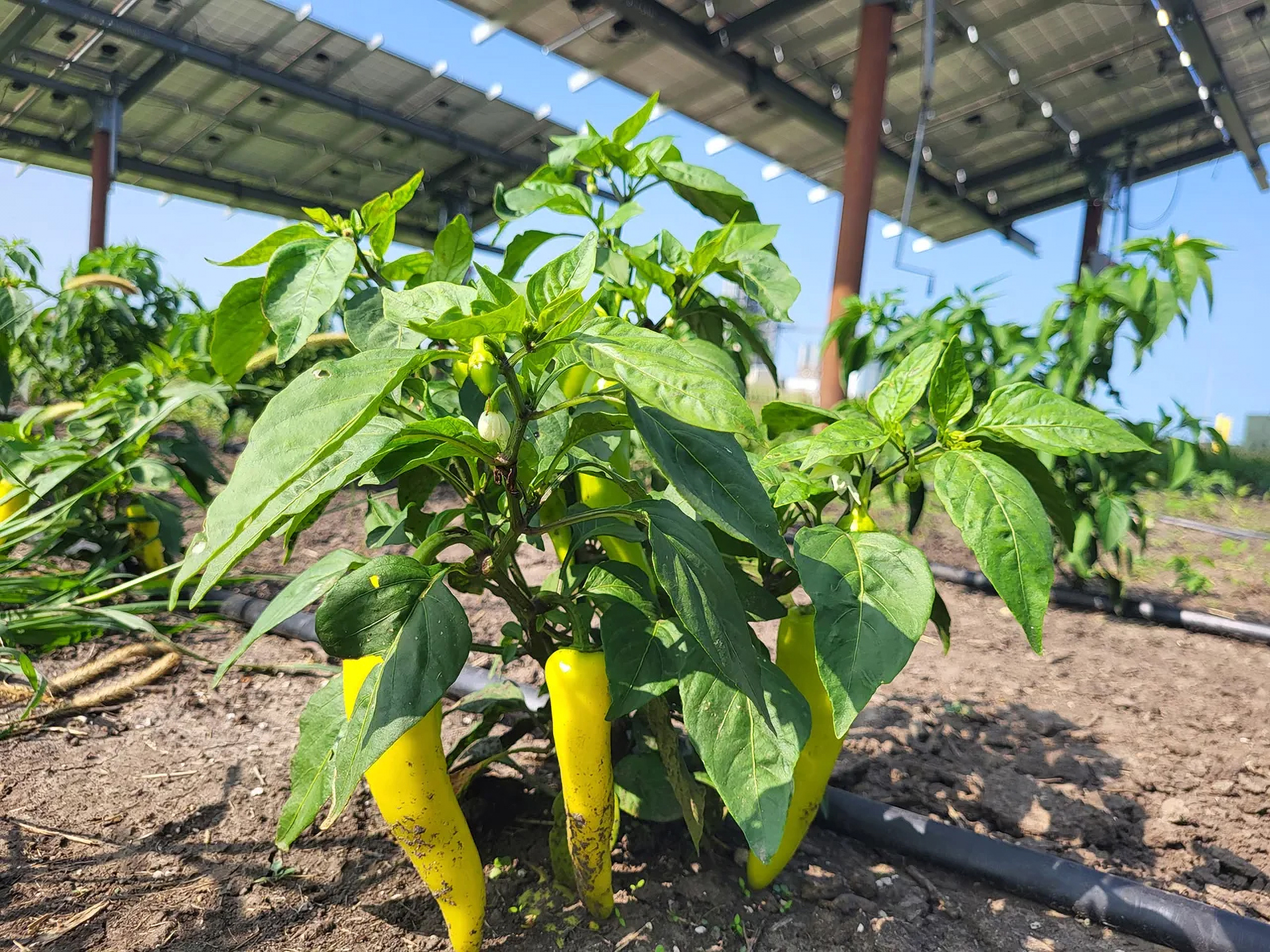
By addressing challenges such as soil erosion, yield stability, and land-use efficiency, agrivoltaics not only supports individual farmers but also lays the foundation for a more secure and sustainable food system.
Studies have long demonstrated that it’s possible to feed 90% of Americans entirely with food grown within 100 miles of their homes, but the challenge has always been how to do so at a price point that is affordable for consumers and profitable for farmers.
Because agrivoltaic farmers are typically paid (either for the use of their land, or to tenant farm solar farms where they serve as de facto “vegetation managers”, or sometimes, both), they have a hedge against fluctuating commodity markets and/or access to land that would otherwise be unaffordable (a boon for first-generation and underrepresented farming populations).
Land leases generally exceed 20 years, while grazing contracts are frequently held for multiple years. There’s no more worrying about whether a war in Ukraine will affect input prices or the commodity market; now, food can be produced with minimal upfront cost and distributed locally, all at a price point that’s affordable to consumers by eliminating the middleman.
Improving Local Food Yields
Despite all this, critics still argue that solar takes food off the table. That argument ignores a question we need to be asking: how much of our cropland is dedicated to non-food crops?
We export 20-30% of our corn, most of which is field corn grown for livestock feed, ultraprocessed food, or ethanol production. With that off the table, that’s a lot more land that’s up for grabs to feed American mouths.
We aren’t feeding Americans with commodity corn. We’re feeding exports and producing ethanol, a highly inefficient biofuel. Multiple studies have demonstrated that we could meet all of our country’s energy needs and power a fleet of electric cars solely by transitioning acreage from ethanol corn to solar.
We often talk about how “yields will be reduced” if we convert farmland to solar, but our current yields are not actually feeding us. They’re feeding, in most cases, cars.
Others have shown that only 10.3 million acres, representing 1 to 1.2% of all US farmland, would be needed for a fully solar grid (to say nothing of the solar that could also be installed on rooftops or other structures). Given that 29.7 acres of farmland are currently dedicated solely to ethanol corn, the swap seems like a no-brainer (and if you’re still married to the idea of growing corn, high-clearance solar, again, allows those activities to continue regardless).
And for farmers already struggling with record-low prices (and a lack of markets, as 2025 tariffs continue to pose problems), this switch may be necessary. As farms continue to go out of business by the day, doesn’t it make sense to switch to crops that can produce high yields, with fewer inputs, that actually feed the local community, rather than being shipped overseas to inefficiently power vehicles?
Energy Efficiency and Environmental Impact

It bears repeating: solar power dramatically outperforms ethanol in energy production. A single solar panel produces 30 to 200 times more energy than corn grown for ethanol, and yields 85 times more driving miles per acre.
Land use estimates aside, this completely flips the narrative that solar energy is an inefficient use of rural land.
The environmental footprint of solar power generation proves similarly impressive. Solar energy is water-efficient, requiring roughly 20 gallons of water per MWh. Coal requires over 19,00 gallons per MWh.
When we think about food security and land use, it’s important to remember that it’s not just about how our land is used but also about our water (water is just as much, if not more, of a limiting factor for expanding agriculture as land is).
Agrivoltiacs is Flipping the Script on Farming
Agrivoltaics presents the most viable path forward for the American farmer. With land access remaining the biggest barrier for young or first-generation producers, dual-use systems give them affordable access to high-quality, high-yielding land without the crippling debt.
The traditional farming cost model is also flipped on its head: instead of a farmer paying high land-rent prices, a solar developer pays the farmer to manage the vegetation (they must control grass and weeds to keep the panels unshaded anyway). Using sheep or cattle is a highly cost-effective alternative to expensive, fossil-fuel-heavy mechanical mowing (especially when high-clearance solar makes it possible to farm without any modifications on behalf of the farmer).
The farmer gains a steady revenue stream while saving money on land access, equipment wear and tear, and fuel. This translates directly to lower food prices for consumers and a more stable, locally focused food supply, not one tied to the global commodities market.
This model works across various scales, and while there are certain challenges that need to be addressed as the industry grows (namely, the need for solar equipment suitable for farming without being astronomically priced for the developer), new companies are rising to meet that challenge. Namely, MT Solar.
MT Solar: Solutions to Increase Solar Production & Boost Food Security
To achieve the dual promise of agrivoltaics, we need the right kind of infrastructure. MT Solar provides an exceptional solar installation from start to finish with mounts that are safe, easy to install, and engineered to last.
If we want to implement agrivoltaics safely and effectively, we need high-clearance solutions and systems that can accommodate the unique demands of farming, such as cattle scratching their backs against the posts. Our solutions eliminate the need to struggle with substandard solar mounts, or unsafe working conditions. We take pride in supporting installers and farmers who align with our values of sustainability, security, safety, and community.
Clearly, agrivoltaics is the best path forward for balancing food security, sustainability, and renewable energy. The numbers are clear. The information is solid. It’s time for us to build a stronger, more resilient food system without sacrificing clean power generation.
The land use dilemma is a false dichotomy. Our options aren’t limited. It’s not a choice between food and energy. We have the opportunity to achieve both. We need to stop leaving money on the table and start cashing in on the dual-use value of every acre.
Contact MT Solar today to learn more about how our innovative, high-clearance mounting solutions can help you embrace agrivoltaics, protect the soil, and secure a highly sustainable future for the American farm and food system.
It’s time to get to work on powering (and feeding) America.